Journal d’Aurélie Laflamme, Le – Film de Christian Laurence

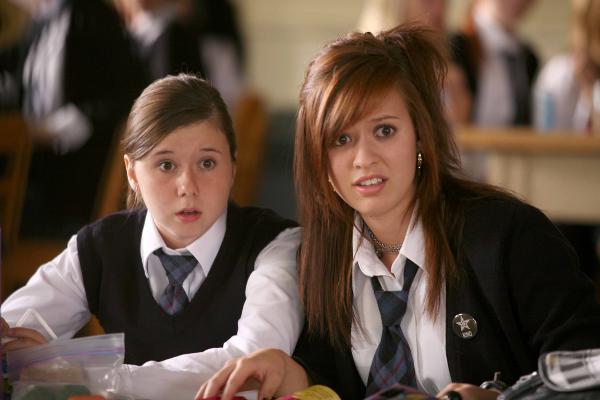
Le Journal d’Aurélie Laflamme est une comédie pour adolescents dont le personnage principal est tiré de la populaire série de livres écrits par l’auteure India Desjardins.

Le journal d’Aurélie Laflamme de Christian Laurence

Le journal d’Aurélie Laflamme de Christian Laurence

Le Journal d’Aurélie Laflamme est une comédie pour adolescents dont le personnage principal est tiré de la populaire série de livres écrits par l’auteure India Desjardins. Ce film est basé sur le premier tome de la série « Aurélie Laflamme, Extraterrestre ou presque ». Le réalisateur Christian Laurence vient du domaine de la télévision et signe ici son premier long-métrage de cinéma.

Comme on pouvait s’en douter d’après les succès obtenus par les livres, Le Journal d’Aurélie Laflamme fut reçu chaleureusement par le jeune public québécois qui en fit l’un des succès au box office de 2010. Au niveau international, le film de Christian Laurence eut droit à quelques sélections dans les festivals francophones, sans toutefois se démarquer outre mesure.

Un second film tiré des aventures d’Aurélie Laflamme a été produit par la suite.

Résumé

Aurélie est une adolescente de 14 ans, un peu perdue et donc en quête de solutions. Entre les habitudes de sa mère sédentaire et les chicanes avec sa meilleure amie, elle rêve à son premier french kiss ! Mais au fond, Aurélie se sent bien seule dans l'’univers, surtout depuis la mort de son père, il ya 5 ans.

Et si son père était simplement un extraterrestre, ayant quitté la Terre pour rejoindre sa planète? Génétique oblige, Aurélie serait elle-même une extraterrestre! Ceci expliquerait bien des choses. Par exemple, pourquoi elle se sent si différente des autres (surtout de sa mère), pourquoi elle n'’est pas capable d’'enligner deux mots sans faire une gaffe, et surtout pourquoi les garçons lui tapent vraiment sur les nerfs.

Synopsis officiel

Distribution

Marianne Verville (Aurélie Laflamme) ; Geneviève Chartrand (Kat) ; Aliocha Schneider (Nicolas) ; Jérémie Essiambre (Truch) ; Edith Cochrane (mère d’Aurélie) ; Pierre Gendron (Denis Beaulieu) ; Valérie Blais (Marie-Claude) ; Sylvie Potvin (Soeur Rose)

Fiche technique

Genre: Comédie dramatique - Origine: Québec, 2009 - Sortie en salles: 23 avril 2010 dans 83 salles au Québec - Durée: 1h48 - Classement: Général - Tournage: septembre-octobre 2009 - Budget approximatif: 4,1 M$

Réalisation : Christian Laurence - Scénario : Christian Laurence et India Desjardins, d'après le roman éponyme d'India Desjardins - Production : Claude Veillet et Lucie Veillet - Société de production : Films Vision 4 - Distribution : TVA Films

Équipe technique - Costumes : Julie-Anne Tremblay - Direction artistique : Marc Ricard - Montage : Hubert Hayaud - Musique : Martin Léon - Photographie : Geneviève Perron
La Chimera asks a radical question: What if we stopped trying to resurrect the past? Arthur is a ghost who can touch ghosts, a man cursed to find exactly what he is looking for and never be satisfied. The film’s magic lies not in the discovery of the lost statue, but in the moment Arthur finally lets the string snap. Rohrwacher suggests that the only way out of the labyrinth of grief is not to find the monster at its center, but to realize that you have become the monster yourself—and then to lie down, finally, beside the ones you have lost.

The film’s secret weapon is its third act, which shifts the setting from the men’s tunnels to the women’s world. Here, we meet Italia (Carol Duarte), the pregnant, practical sister of Beniamina, and Flora (Isabella Rossellini), an imperious former opera singer who runs a ramshackle music school out of her crumbling villa. Where the men steal to possess, the women build to sustain. The final sequence, a breathtaking, vertiginous journey through a necropolis that connects the past to the present, is not a treasure hunt. It is a funeral procession.

The chimera of the title is the impossible dream—the thing you chase that doesn’t exist. For Arthur, it is literal: a statue of a mythological creature he once saw in a tomb, and the ghost of his lost love, Beniamina. He is a broken English archaeologist with a supernatural gift for finding the dead, yet he cannot find his own way out of grief. Every stolen vase and sarcophagus is a failed substitution for the woman he couldn’t save.

It is a strange, beautiful, and devastating film—a folk tale about capitalism, colonialism, and heartbreak, where the real treasure is the permission to stop digging.

On its surface, La Chimera is a heist movie for antiquarians. Set in 1980s Tuscany, it follows a gang of eccentric tombaroli (tomb raiders) who use dowsing rods to locate lost Etruscan graves, plundering them for artifacts to sell on the black market. But Rohrwacher has no interest in the thrill of the score. She is interested in the hole left behind.

Alice Rohrwacher’s La Chimera opens not with a bang, but with a tug. Arthur Harari’s protagonist, the lanky, disheveled Arthur (Josh O’Connor), is yanked back from the brink of the afterlife by a frayed piece of string. He lands on a mattress in a dusty train depot, and we realize we are watching a film about verticality: the pull of the underworld versus the weight of the sun.

Rohrwacher shoots this world in two registers. The sun-drenched surface—full of squabbling thieves, pasta dinners, and a chorus of middle-aged women singing off-key—is rendered in warm, grainy 16mm. It is chaotic, earthy, and alive. But when Arthur dips his rod and feels the pull of a buried chamber, the film cuts to 35mm, and the colors bleed into dream. The subterranean world is quiet, solemn, and full of the dead. Rohrwacher does not moralize about the grave robbing; she treats the tombs as libraries, and the tombaroli as illiterate poets who know the price of everything but the value of nothing.